
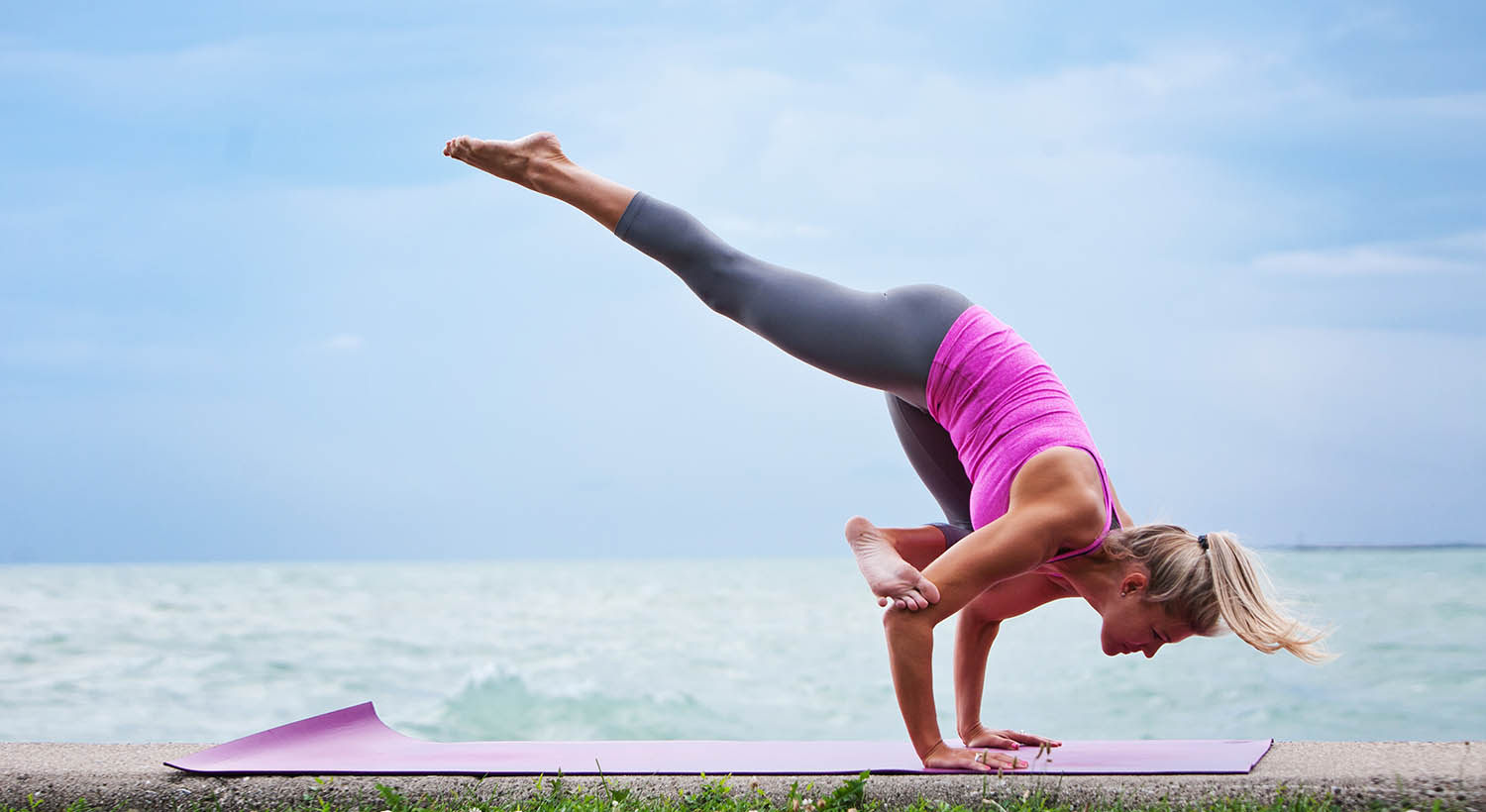
One-legged poses give us a chance to find our center of gravity and dance around its edges. Here's how to still the wobbling and create a sense of fluid stability.
One-legged poses give us a chance to find our center of gravity and dance around its edges. Here's how to still the wobbling and create a sense of fluid stability.
When world-famous yoga master B.K.S. Iyengar visited the San Diego Zoo in 1990, he was struck by the effortless aplomb of the flamingos. He pointed to a gaudy pink bird as it balanced on one foot, steady as a boulder. Oblivious to its squawking neighbors, beak tucked under its feathers, the flamingo was fast asleep. Surveying the group of yoga teachers accompanying him, Iyengar playfully challenged them: "Can you relax like that?"
The answer, of course, was no. For humans, nodding off while balancing on one leg is out of the question. Even relatively simple balances like Vrksasana (Tree Pose) and Ardha Chandrasana (Half Moon Pose) demand our full, wakeful attention in a way that other standing poses do not. There's no faking it: The instant we lose focus, we fall over. There is an unavoidable immediacy to these balancing asanas. Standing on one foot, we naturally drop extraneous thoughts to focus on the task at hand. That's why these poses can instill a deep sense of calm even though they require intense, unwavering alertness.
When we balance, we align our body's center of gravity with the earth's gravitational field. Quite literally, we place ourselves in physical equilibrium with a fundamental force of nature. But we can't achieve this harmony by remaining absolutely still. Instead, we must refresh our balance moment after moment. The sustained effort to center and recenter, when successful, brings not only our flesh and bones into balance but also our nerve impulses, thoughts, emotions, and very consciousness. Hence, we feel calm. Equilibrium brings equanimity.
Lack of equilibrium brings just the opposite. There is something uniquely frustrating about losing our balance in one-legged postures. It goes beyond the instinctive fear of falling and strikes directly at the ego. After all, we rarely tumble to the ground and hurt ourselves; we simply put our other foot down. Yet that simple act can be maddening.
If we fall out of Vrksasana when practicing alone, we often hear an internal critic saying, "What's wrong with you? You should be able to do this!" If we're in a class, the same fall can bring a sense of humiliation that's greatly disproportionate to the physical event. We feel out of control when we lose our balance, and the ego hates to lose control—especially when other people are around to see it.
Despite the frustration, one-legged balancing asanas offer so many benefits that it's well worth the trouble to practice them. In addition to promoting concentration and calm, these poses strengthen our muscles and build our coordination and balance, improving our ways of standing and walking as well as how we perform many other everyday activities. And these benefits might actually prolong our lives, helping us avoid the falls that often lead to injuries and death among the elderly.
The three essential elements of balance are alignment, strength, and attention. Alignment of the body with gravity is crucial; it makes balance physically possible. Strength gives us the power to create, hold, and adjust alignment. And attention continually monitors alignment so we know how to correct it from one moment to the next.
In many ways, balancing the body on one leg is much like balancing a seesaw. The same laws of physics apply: If you align the center of gravity over the base of support, you balance. If you don't, you don't. It's as simple as that. Of course, since your body is quite a bit more complicated than a seesaw, balance is often not so simple to achieve.
Let's explore Vrksasana to see how alignment with gravity works in a one-legged balance. When you stand in Tadasana (Mountain Pose) preparing for Vrksasana, your feet form your base of support. The center of gravity—the point you need to place exactly above the center of your base in order to balance—varies a little from person to person. But it's generally a little below the navel, deep inside the belly; and, since humans are more or less symmetrical right to left, it's right on the midline. If you stand in front of a mirror and imagine a plumb line that runs from the ceiling to the floor and passes through this center point, you can see that it ends right between your feet, at the center of your base of support. Your weight is evenly distributed on either side your midline. It's pretty easy to balance here.
But the moment you lift your right foot off the floor and start to draw your right knee out to the side for Vrksasana, everything changes. Your base of support becomes narrower; now it's just your left foot. And the weight of your leg swinging out to the right moves your center of gravity to the right, so it's no longer on your midline. To compensate, you automatically shift your whole body to the left, working to bring your center of gravity back onto the new plumb line that runs through your new base of support.
To do this, you must distribute your body weight in equilibrium on either side of the plumb line. But it's important to understand that distributing your weight in equilibrium doesn't necessarily mean placing equal weight on each side of the line, as you do in Tadasana. To illustrate how distribution of weight works, think of two people of unequal weight trying to balance a seesaw. They can balance if the lighter one sits farther out and the heavier one sits closer to the center.
In yoga, the same principles apply: A light part of the body far away from the center of gravity can counterbalance a much heavier one that's closer to that center. In Vrksasana, for instance, as your relatively light bent leg moves out to the right, quite a ways from your center, you counterbalance by moving heavier body parts—your hips and torso—slightly to your left. Just like two people striving to maintain balance on a seesaw, you must pair any movement you make on one side of the plumb line with an opposing movement on the other side.
Every time you use your arms to balance by holding them out to the sides like a tightrope walker, you're intuitively taking advantage of the fact that as weight moves away from your center of gravity, it has a greater effect on your equilibrium. If you have difficulty in Vrksasana and other one-legged balances, by all means use your arms to help stabilize yourself.
It's obvious that moving your center of gravity horizontally affects your balance, but moving it up and down can have an equally dramatic effect on your pose. You've probably noticed that Vrksasana becomes a little more difficult to balance in when you bring your hands from your sides to prayer position at your heart, and even harder when you take your arms overhead. That's because each of these movements raises your center of gravity. When the center of gravity is high, just a few degrees of tilt can move it far enough off the plumb line to upset your balance; when it is low, there's more room for error. If you have trouble balancing in Vrksasana, try lowering your center of gravity by practicing the pose with your standing-leg knee slightly bent and the arms in a lower position. Only straighten the knee and raise the arms overhead after you have achieved success with the knee bent. Starting with the knee of the standing leg bent can also be very helpful in the other one-legged balances.
You can also enhance your equilibrium in these poses by spreading the toes and the ball of the standing foot. The broader your base, the more stable you are, and even the slightest widening of the sole of the foot is surprisingly helpful.
Although one-legged balances all have much in common, each also presents specific challenges. In Vrksasana, for instance, you are especially likely to fall toward the inner edge of your standing foot. When you're first learning the pose, one way to counterbalance this tendency is to shift the hips a little more in the opposite direction, bringing more weight onto the outer edge of the foot. This movement can keep you balanced long enough to build strength, endurance, and, eventually, more vertical alignment.
Another way is to use the strength of your foot and lower leg muscles to shift your center of gravity. Actively pressing down into the big-toe ball of the foot and the inner heel causes a rebound up through your body and shifts your center of gravity toward the outer edge of your foot; pressing into the outer edge of the foot shifts your center of gravity more over the inner edge. Such skillful use of your muscles is an important part of balancing. While alignment with gravity is crucial, your bones can't put themselves into line; they need the muscles to move them into position, hold them there, and reposition them as needed. This is where strength comes into the picture.
When you stand on one foot, one leg must do the work of two. To appreciate how important strength is in balancing, let's take a close look at the muscles used in Utthita Hasta Padangusthasana (Extended Hand-to-Big-Toe Pose).
As you stand in Tadasana in preparation for the pose, each hip is supported by the leg below it. The instant you lift one foot off the floor, the foundation of the hip on that side is pulled out from under it. Yet you usually don't collapse toward the ground. What holds you up? Two muscles in the opposite-side buttock, the gluteus medius and the gluteus minimus, do most of the work. These are the two most important muscles to strengthen to improve all of your one-legged balancing poses.
The gluteus medius connects the outer rim of the pelvis to the upper thighbone, and it's easy to find. (The gluteus minimus lies underneath the medius, so it's harder to palpate.) You can feel your left gluteus medius by first running your left fingertips along your pelvic rim until they're exactly at the side of your body, then sliding them down about two inches and pressing them into the flesh.
If you continue pushing on this spot as you lift your right foot, you will feel the gluteus medius harden beneath your fingertips. It will contract the instant the foot leaves the floor, and it may get even firmer as you progress into Utthita Hasta Padangusthasana, especially if you do the variation with the lifted leg off to the side. The gluteus medius and gluteus minimus of the standing leg must work very strongly in this variation, because lifting your other leg so far out to the side gives its weight tremendous leverage to pull that whole side of the trunk down. The gluteus medius and minimus of the lifted leg are also very active in this pose. That's true for some of the other one-legged balances too, including Ardha Chandrasana and Virabhadrasana III (Warrior Pose III).
The best way to strengthen these crucial muscles is—you guessed it—to practice lots and lots of one-legged standing poses! All the poses discussed in this article will help; each will work the muscles in a somewhat different way. To maximize the value of a pose for strength training, try practicing it with the support of a wall or ledge so you can hold it for a long time without losing your balance. Hold it until muscle fatigue causes you to lose proper positioning of your limbs or trunk. Then come down and practice on the other side. You'll get even better results if you repeat this process several times.
Smaller muscles are also important in helping you balance in poses like Vrksasana and Utthita Hasta Padangusthasana. When you stand in them, you'll probably find your foot and ankle making frequent side-to-side adjustments. The inner foot presses down (pronation), then the outer foot (supination), then the inner foot again, and so on. If you pay attention to this involuntary small dance, you'll see that pressing down the outer edge of the foot shifts the body's center of gravity toward the inner foot, and vice versa.
Being narrow, the foot has very poor leverage for shifting the entire mass of the body left and right. The muscles that press the inner and outer foot down must, therefore, be quite strong to move the center of gravity far enough—and fast enough—to maintain balance. The primary muscles involved are the tibialis anterior (on the outer front shin) for supination, and the peroneus longus and brevis (on the outer calf) for pronation. The supinators are strengthened by almost every standing pose, one-legged and two-legged alike. The pronators are strengthened more by one-legged standing poses, especially Vrksasana, in which they help offset the tendency to overbalance toward the inner foot.
The better you get at balances, the less muscular effort you need to maintain them. This is because you become more skilled at using your bone structure to support your weight, rather than wasting muscle energy to do so. You also waver less, so you need to make fewer and smaller muscular corrections. Such finesse often depends on practicing other poses to gain adequate flexibility, which allows you to place your center of gravity in the most favorable position. It is important not to try to muscle your way through balancing poses, replacing good alignment with brute force. If you find yourself clenching the floor with your toes, white-knuckled, there's a good chance you are using too much brawn and not enough brain.
Of course, some one-legged poses, such as Virabhadrasana III and Parivrtta Ardha Chandrasana (Revolved Half Moon Pose), will always require a great deal of muscular action. But if you use alignment wisely in such poses, you can save your strength for where it is needed. And you discern where it is needed by honing your powers of attention.
Bori Colony, Marol, Andheri East Mumbai, Maharashtra 400047.
Phone:
+91-7373380029
Email: